
 EN
EN
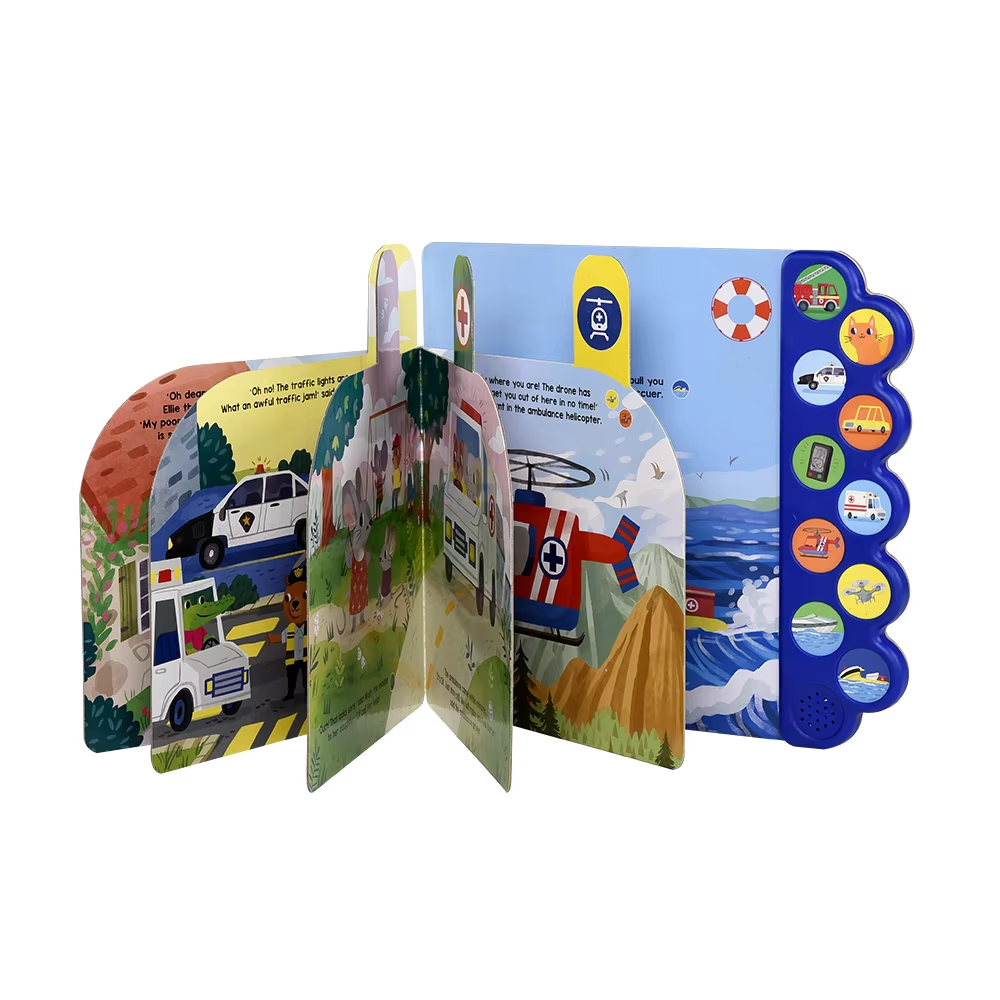
The Science Behind Interactive Educational Toys and Cognitive Development
Interactive educational toys engage children through multisensory experiences that directly shape brain development. When a child presses a button that emits a sound, sees a matching light, and feels a textured surface, the simultaneous feedback activates neural pathways linked to higher-order thinking.
Neurocognitive benefits: How tactile, auditory, and visual feedback strengthen executive function
Executive function (EF)—encompassing working memory, inhibitory control, and cognitive flexibility—is foundational for problem-solving and academic success. Multisensory feedback from interactive toys strengthens EF by engaging multiple brain regions in concert. Neuroimaging research shows tactile and auditory cues reliably increase prefrontal cortex activity, the neural hub of EF (Giedd et al., 2019). For example, a shape sorter that lights up only when the correct piece is placed requires the child to hold the sorting rule in working memory while actively suppressing incorrect attempts—an authentic EF workout. A 2020 meta-analysis found structured play with interactive tools yields a moderate but consistent effect on EF gains (Cohen’s d = 0.62) compared to passive toy use. In a controlled study, toddlers using push-button sound puzzles demonstrated 23% stronger response inhibition in delay-of-gratification tasks after just eight weeks of daily play (Diamond & Lee, 2021). By reinforcing the link between action, consequence, and sensory feedback, these toys train adaptive thinking—the ability to revise strategies in real time.
Developmental alignment: Supporting Piaget’s sensorimotor and preoperational stages through interactive design
Interactive toys align precisely with Jean Piaget’s developmental theory. During the sensorimotor stage (birth to age 2), infants construct knowledge through direct physical interaction. Ring stackers that wobble, musical balls that roll and chime, or cause-and-effect pop-up toys help infants grasp object permanence and early cause-effect reasoning. A six-month-old shaking a rattle learns that intentional movement produces predictable sound—a vital step toward goal-directed behavior. As children enter the preoperational stage (ages 2–7), they begin using symbols and engaging in representational play. Interactive tools like programmable floor robots—where picture cards map to physical movement—support this shift by bridging concrete action and abstract sequencing. A longitudinal study tracking 150 preschoolers found those regularly using such cause-and-effect toys advanced more rapidly through Piagetian substages, particularly in conservation and classification tasks, than peers using non-interactive alternatives (2018). This intentional developmental fit ensures challenge without overwhelm—keeping engagement high and frustration low.
Playful Exploration as Purposeful Problem-Solving Practice
Productive struggle in action: Trial-and-error learning with programmable and puzzle-based interactive educational toys
The most effective interactive toys don’t deliver answers—they create conditions where exploration becomes structured problem-solving. This “productive struggle” transforms simple actions—like inserting a puzzle piece incorrectly—into rich learning moments. Tactile resistance combined with mismatched visual feedback signals an error, prompting immediate hypothesis testing: What if I rotate it? Try a different slot? This loop—predict, act, observe, adjust—is the scientific method in miniature. Unlike passive instruction, this self-directed process builds durable understanding because the solution emerges from the child’s own reasoning.
Programmable toys deepen this cycle by introducing logic, sequencing, and delayed outcomes. A child arranging command blocks to guide a robot through a maze must anticipate spatial relationships and temporal order. When the robot turns left instead of right, the error is visible, objective, and free of judgment—inviting debugging rather than discouragement. The child refines their mental model not to earn praise or points, but to restore alignment between intention and outcome. This iterative practice cultivates resilience by redefining failure as a solvable information gap—not a reflection of ability—and sharpens the flexible, persistent mindset essential for advanced problem-solving.
Design Features That Maximize Problem-Solving Transfer
Scaffolding complexity: From stacking blocks to block-based coding — honoring the zone of proximal development
Truly effective interactive toys function as dynamic cognitive scaffolds, calibrated to Vygotsky’s Zone of Proximal Development (ZPD)—the sweet spot between what a child can do independently and what they can achieve with just-right support. These toys evolve alongside the child, introducing challenges that stretch—but don’t exceed—their current capacity. A toddler begins stacking physical blocks to grasp balance and spatial reasoning; the same platform may later introduce digital block-based coding, where drag-and-drop commands animate characters. This progression from concrete manipulation to abstract logic preserves continuity while advancing cognitive demand.
A programmable robot kit exemplifies this principle: early tasks involve single-direction commands (“move forward”), while later challenges require nested loops or conditionals (“if red light, turn left”). Crucially, feedback is immediate and functional—a green light for success, a gentle vibration for instability—not evaluative. This responsive design provides the precise nudge needed to convert struggle into insight, ensuring each mastered skill unlocks the next appropriately scaled challenge. Over time, this deliberate scaffolding transforms isolated problem-solving into a transferable, self-sustaining habit of mind.
Evidence of Real-World Skill Transfer and Long-Term Impact
Longitudinal outcomes: Correlations between early use of interactive educational toys and later STEM reasoning proficiency
Emerging longitudinal evidence confirms that early, sustained engagement with interactive educational toys predicts measurable advantages in STEM reasoning later in life. A 2023 analysis of early childhood learning patterns found children who regularly used problem-solving toys—especially those offering immediate feedback and incremental challenges—scored 23% higher on standardized middle-school STEM assessments than peers with limited exposure. These gains reflect more than rote knowledge: the toys foster neural efficiency in executive function and abstract reasoning—core capacities underlying scientific thinking. Critically, follow-up studies controlling for socioeconomic status, parental education, and school quality still identified early interactive play as a significant, independent predictor of adolescent STEM interest and achievement. This robust correlation affirms that playful, hands-on exploration with well-designed interactive tools lays durable cognitive groundwork—equipping children not just with facts, but with the reasoning habits that power lifelong learning and innovation.
FAQ Section
What are interactive educational toys?
Interactive educational toys are designed to engage children through multisensory experiences. They often provide tactile, auditory, and visual feedback to encourage learning and cognitive development.
How do interactive toys support cognitive development?
Interactive toys strengthen executive function, including working memory and problem-solving skills. They activate multiple brain regions through multisensory feedback and ensure mental engagement in activities like sorting, sequencing, and reasoning.
Are there specific developmental stages these toys target?
Yes, interactive toys align with developmental stages, such as Piaget’s sensorimotor and preoperational stages, by offering age-appropriate challenges that support exploration, reasoning, and symbolic play.
Can these toys improve STEM skills?
Research indicates that early engagement with interactive toys enhances STEM reasoning and problem-solving skills, leading to long-term benefits in science, technology, engineering, and math.
What is the "zone of proximal development" in interactive toys?
The "zone of proximal development" refers to challenges that a child can solve with minimal support, enabling gradual learning through scaffolding in interactive toys.